Tuesday, May 15, 2012

How and Why I think I am Devastated: Face of Malawi Plagiarised My Blog Post


I was going through news posted on Hacker News on Y Combinator. Suddenly I bumped on a link that simply said “Plagiarism”, so I was curious to read it. In the article, Joshua Gross, complained that TheNextWeb plagiarised his blog post entitled The $144,146,165 Button. He even cited some sentences where TheNextWeb copied word for word. The article shows he is very much devastated, and I do understand now that he has a good reason why he is devastated like that.

On Friday 11 May 2012, I wrote an article about How and Why I think Malawi has to Move on with Software Localization. I published it on that day because it was the birthday of Professor Kevin Scannell of Saint Louis University, one of my friends and mentors in natural language technologies. Prof. Scannell is the developer of http://indigenoustweets.com/, a site that collects tweets and blogs in under-represented languages. Prof. Scannell and I have been close friends for close to 5 years now and publishing the post was a subtle way (quoting his words on chat) of saying happy birthday to him. I kept the post in my Kanjedza (that is the name of my laptop) since 30 April 2012 when I conceived it.

I developed the blog-post from a comment I made on a picture on Facebook. A friend of mine, Patrick Kalamula of PatKay Graphics, tagged me on a graphic captioned Microsoft Mawu, depicting Microsoft Word with a Chichewa interface. I was a excited about it, a wishful thinking I may call it. I was responding to Patrick's comment that he would not love working on a Chichewa word processor because he finds even the Chichewa bible hard to understand. I can actually hinted that I would just copy and paste-blog it. You can check my comment is still there on Microsoft Mawu.

Joshua Gross article on plagiarism made me think twice about my blog post. I did a simple search on Google to see how many have written something similar to what I just blogged. I was very much astounded to find that Face of Malawi plagiarised my post. I am have been very much devastated too.
What Face of Malawi have done is just making a word for word copy-and-paste of my post. They have not changed anything. I am sure they got it from Twitter where I posted soon after publishing it. What they have managed to do is to paraphrase the article title and add a picture on it. They were too quick to plagiarise such that they copied it before I edited a few things on it. The time I was writing this post, I could still see my silly mistakes on their post:
  • But language regulatory bodies and linguists always have great concerns over the “unsupervised growth” of terminologies. (I removed quotes in this statement because the phrase unsupervised growth was italicized and I wanted to keep formatting uniform.)
  • Chichewa is just 38% (5/13 — ija, Panopa, pa, ina, yake). (I left the word Panopa titleized)

  • I have always argued on elsewhere that it is volatile and unpredictable. (In my original post, I replaced the word Twitter with elsewhere and forgot to remove the preposition on)
You will also notice that the post on Face of Malawi is lacking some statements that I added later on:   
  • Both mean the same: "Some banks were opened long ago but they do not have a lot of customers"
  • The whole issue of localization comes to a bottleneck because there seem to be a tag of war between developers of new terminologies and users of such terminologies. Terminologists are fast developing new terminologies when the users are not ready or willing to use them. In languages of business, terminologies easily flow in. But that leaves other languages with the task of generating new terminologies or risk dilution.
They have not asked for my permission to repost it on their site. I am a simple blogger, they are a giant website. If you search my article on Google, their plagiarised article is appearing on top. It may look simple but this is distracting. My readers' traffic is technically being detoured from my original post to theirs.

I think what Face of Malawi have done is not good and should not be condoned. There are better ways of copying someone's work. They could drop me an email, asking for permission. Of course, I have no problems in anyone publishing my views but they should inform me first. I am proud to see my views being cherished out there. What I write on my blog are personal views and they cannot even defend why I wrote the way I did, and so they have no authority to plagiarise they way they did. I would ask them to apologise and recognise that I wrote it first. I am sure I have not offended anyone in publishing this.

Friday, May 11, 2012

How and Why I think Malawi has to Move on with Software Localization


We are in the technological era and the use of ICT is not news any more. Even in the remote areas of Africa, we find someone using at least a mobile phone. It has been argued that even smart phones are becoming more popular in villages. This is good news, but not everyone is enjoying this to the maximum. Let's face the reality, a larger section of villagers are not enjoying the services that we all enjoy: blogs, social media (WhatsApp, Twitter, Tumblr, Facebook, Skype, etc), you name them. Most of them just know how to make and answer calls. A few more are able to read and compose text messages, otherwise I have seen many more that do not even know what to do when text messages come on their phones.

I have always argued in various forums that in order to remove this language barrier, software localization is one of the best alternatives to make ICT appropriate to a target population. Localization of software involves adapting technologies to the linguistic, cultural and technical requirements of a target group of people. However if not handled carefully, software localization cannot achieve its intended purposes. One of the problems that native speakers find is to manage the influx of new terminologies that are begging their way into the language vocabulary. Generally, most people do not mind much about that as far as they communicate. But language regulatory bodies and linguists always have great concerns over the unsupervised growth of terminologies.

Somehow, leaving the terminologies to grow by themselves is very dangerous. Since a lot of terminologies that come in are loaned, they pose a lot of threat to the linguistic and phonological structures of the target language. For example, in Chichewa, the term banki is borrowed from the English word bank. The plural is banki or mabanki, and it is not clear yet which is the correct form. Regular users may not necessarily think that this is an issue, but for linguists it poses a lot of problems and inconsistencies in trying to grammatically categorise words like these. You may also wish to recall that Chichewa nouns affect sentence structure because they determine the right argument markers (called agwirizanitsi in Chichewa) to associate with. In Chichewa noun system, the noun banki belongs to class 9. Generally, class 9 plurals are in class 10. Thus, banki (sing. Class 9) => banki (pl. class 10) makes sense, while banki (sing. Class 9) => mabanki (pl. class 2/class 6) does not, yet it is the mostly used plural form. Compare the markers in the following two sentences: Banki zina zinatsegulidwa kale koma zilibe anthu ambiri. and Mabanaki ena anatsegulidwa kale koma alibe anthu ambiri. Both mean the same: "Some banks were opened long ago but they do not have a lot of customers") This is the case with other loanwords like ofesi (office), kapu (cup) et cetera. (For those that do not understand this number-based noun classification system: the word banki sounds to nicely belong to I-Zi class, but using mabanki creates a new classification, I-Ma, which is ungrammatical; just as pluralizations nkhuku => mankhuku and nyanja => manyanja can sound very awkward).

The worst case scenario is where the language becomes completely immersed into another language. Look at this Chichewa sentence in youth slang: Ndatrapa ngini ija magaye. Panopa ndikudona pa nide, titchekana boboo thayimu ina yake. Chichewa is just 38% (5/13 --- ija, panopa, pa, ina, yake). The rest is Chinglish: Chichewalised English. If we juxtapose it with an equivalent English sentence, it can be seen that this phrase is “skin-to-skin transliteratable” (forget about semantics here): I have trapped that thing, guys. I am downing to my den. We will check each other some time. So little by little English is eating away our language and if anything cannot done as soon as possible, we will lose out our beautiful language. Of course, I have a problem with youth slang. I have always argued elsewhere that it is volatile and unpredictable. As such, we cannot rely on it very much though we cannot deny the fact that it is influencing Chichewa language in general.

Linguists tell us that language (just like any cultural element) is dynamic. We take English as an example: In 1500-1600s, no one raised eyebrows if you spoke like this: I hath purposed to come unto thee, but was let hitherto. In this statement let means to prevent from. But you can agree with me that the word let now means allow as depicted in this phrase: Please let me go. This is exactly opposite to the original meaning . Similarly, the word gay does not carry the same meaning it used to carry some few years ago, because it is now more associated with sex orientation and not necessarily excitement. Chichewa has also changed overtime. For example, Chichewa that is in the widely used bible version, Buku Lopatulika ndilo Mawu a Mulungu, was translated by William Percival Johnson in 1912 and ever since it has not been modified. (By this, I am not referring to these parallel translations/versions: Malembo Woyera or Buku Loyera). There are some grammatical and semantical errors but Bible Society of Malawi is afraid to correct them (I don't know why). Leaving that aside, 1912 Chichewa is not the same as 2012 Chichewa. Exactly 100 years have passed and there are a lot of things that have changed about Chichewa language. For example, 1 Timothy 3:6 is translated as Asakhale wophunza. Wophunza means novice, but it took me time (and age) to grasp its meaning and understand that wophunza is the root for wophunzira (student). Nowadays, a better translation would be Asakhale wongobadwa mwatsopano (i.e. He must not be a new convert). In addition, in those days a town was called mudzi but today we know it as tawuni, and indeed tawuni is not mudzi (village). Given another 100 years or so, Pure Chichewa will not be the same.

The whole issue of localization comes to a bottleneck because there seem to be a tag of war between developers of new terminologies and users of such terminologies. Terminologists are fast developing new terminologies when the users are not ready or willing to use them. In languages of business, terminologies easily flow in. But that leaves other languages with the task of generating new terminologies or risk dilution. However, localization when viewed from a positive angle, it is a way of preserving a language. It is well-known that languages from the West are mostly associated with economic influence and are little by little subduing other indigenous languages.

In this technological era, every language that wants to survive has to move with fashion. English is fast adapting. Words like mouse, server, breadcrumbs, web do not have same meanings as they used to before 1960s. Similarly, words like blog, facebook (verb), google (verb), tweet (verb) have just born now with the invention of technology. So what is all this noise I am trying to make? We still need translation for our languages to survive and also for the larger section of Malawians that do not understand English. But we need to adjust with time. The language should retain its originality without imposing unnecessary rigour to contemporary readers/writers.

Saturday, December 03, 2011

English-Vernacular interpretation in Churches

Most people have been asking a question as to why in Malawi preachers like to preach in English/Vernacular interpretation. I know some of us also have the same question. We might be going to that church, listening to such preachings and enjoying them at times when the Holy Spirit touches our soul, but we are too perplexed by them.
English-to-Vernacular preaching is very common in pentecostal, charismatic, baptist or evangelical churches. Most of us have ever been asked by someone outside our faith “Why does your pastor preach in English with a vernacular interpreter?” But we have never answered them correctly because we are not sure too! However, with all the relevance we have towards men of God and the fear of pouring the wrath of God upon our life, most of us have never taken an initiative to ask our pastors why this happens like this. 
I would like to address this question here today. I am speaking as one of the men of God who stands in front of people sharing the Word. At times I do the English/Vernacular interpretation, either as the protagonist or as the interpreter himself. I hope this will help someone out there to understand why we do English-to-Vernacular interpretation in our churches.
Before I dive into the topic, let me say that this question came from a friend in one of the forums I am affiliated to. I responded to it, then I felt that I should blog the response I gave so that it helps others too. I had to request the friend for permission to blog my response for the benefit of the multitude, lest he feels offended :-) and he gave me a go-ahead!
I would like also to make it clear that I am using the term vernacular in place of any other indigenous language that can be used for interpretation. I know in most Malawian churches it is Chichewa, but I have also found others interpreting in Chilhomwe, Chiyao and other indigenous languages. In addition, the views here also apply to other communities in the diaspora, especially in Africa, where most of the languages of business happen to be of European origin. In the same view also, the term English should be taken as generic for any non-indigenous “business-oriented” language. 
Sometimes, interpretation becomes complex. I recall once in my Church there came a preacher from Congo who only understood French. He came with one friend who could understand French and English. We had to do a two-state interpretation: French to English to Chichewa. It was that experience that propelled me to study French.

Pastor Aubrey Mwasinga (right) through a Chichewa Interpreter

But why English-Vernacular Interpretation in the Church?

Generally, the choice of using a language when preaching has equally the same reasons and implications as to why we try to use English on social networks like Facebook, Skype or in an email when we know that we are addressing our fellow Malawians. 

In most of the pentecostal churches (just with other churches as well), there is a great chance of finding Non-Malawian Citizens worshipping together with Malawians. Unfortunately, because of long church services, most pentecostal churches are not fond of having double streams: English and Chichewa.

Some preachers find English-vernacular interpretation providing with them some authoritative power to preach. They feel "possessed" by the Spirit. This might be funny to someone who does not understand the spiritual implications of it, but take it from me - they really do feel the power of God in that sense. Know that God uses us the way we often feel him. He is polymorphic: He responds to the way we come to him at different intervals.

We should understand that being an interpreter in a Church is also a special spiritual gift. St. Paul in 1 Corinthians 12 says "Now, dear brothers and sisters, regarding your question about the special abilities the Spirit gives us. I don't want you to misunderstand this... A special gift is given to each of us as a means of helping the entire Church... Still another person is given the ability to speak in unknown languages, another is given the ability to interpret what is being said. It is the one and Only Holy Spirit who distributes these gifts. He alone decides which gift each person should have." (NLT).

Interpretation is a form of evangelism tool. This point is very much related to the previous one. Being a spiritual gift itself, interpretation can be a blessing to the church. Many of us know English but not everyone of us can do the interpretation well. You will discover that when some people interpret, the entire church bursts into laughter: not that the interpreter is erring, but the way the interpreter makes a choice of vernacular terms to spice up the preaching makes their interpretation unique. And members do not slumber in the church as the preacher is preaching. It is a special gift. Now pastors love to leverage that skill in the church to edify the congregation.

Some preachers feel that they can articulate the points better in English. Maybe because their vernacular vocabulary (especially Chichewa) is not as good as that of English (in one way or the other). This point closely related to that of interpretation being a spiritual gift. Such preachers find that their choice of words in vernacular is not as authentic as they would love it to be. Instead, they love to make use of the gift of interpretation that exists in the church.

Some preachers find English-Vernacular interpretation giving them better vocabulary combination. Such preachers love to play with words to make their sermons unforgettable. They like using:
  •  rhymes e.g. "Life without Christ is Crisis", 
  • backronyms e.g. "Brothers, be FOCUSED in your faith. That is being Faithfully On Christ's Unfailing Side Every Day" 

  • puns e.g. "Seven 'prayerless' days make one weak."
One thing we should not forget is that each language has some sentence patterns and pithy expressions that sound better when said in those languages than when said in the other languages. So the combination of vernacular and English exploit the pithy expressions in these two languages.

Some verses are well understood if translated directly from a particular English version. The reason is English is indisputably the only Language with so many Bible translations. As an example, I will give you a verse that used to perplex me when I was young. I never understood them clearly till I read the English version. More importantly, I got several perspectives of the same verse from different English versions. 1Timothy 3:6 in Chichewa reads:
  • "Asakhale wophunza; kuti podzitukumula umgwere mlandu wa mderekezi" (From Buku Lopatulika version. I am not sure how it is translated in Buku Loyera version - maybe someone can provide). 
English has several translations that can be applied differently, depending on the revelation that the Lord is trying to relay to his people: 
  • "Not a novice, lest being lifted up with pride he fall into the condemnation of the devil." (KJV),
  • "An elder must not be a new Christian, because he might be proud of being chosen so soon, and the Devil will use that pride to make him fall." (NLT),
  • "He must not be a recent convert, or he may become conceited and fall under the same judgement as the devil." (NIV)
  • "He must not be a recent convert, so that he won't become arrogant and fall into the devil's condemnation." (ISV)
  • "not a novice, lest being puffed up he fall into the condemnation of the devil." (ASV)
You can notice that the different versions give additional information, some of which is hereby underlined, that when translated directly provide a better understanding than just using the vernacular version only. So pastors do use varying English translations to provide a wider understanding of the same verse with a particular emphasis to what the Lord has revealed to them as a specific need for the congregation.

These are just some of the reasons that preachers have behind English-Vernacular preachings. I hope you are blessed by this and at least you  know a few reasons. Next time someone asks you, you will be able to explain to them. Stay blessed!!!

Monday, October 10, 2011

Dart, What's that? Teascript!!

In a dramatic turn of events, a year after Google announced that it has aborted Gears development in favour of HTML 5, Google has released a client-based competitor for JavaScript in the name of Dart. Indeed, the main goal of Dart is to replace JavaScript (aka Coffeescript) as the main built-in scripting language in web browsers to try to solve JavaScript's inherent problems.

In an internal circulation that was leaked out, Google says that the complex web applications that it specializes in are struggling against the JavaScript platform and working with, [JavaScript], a language that cannot be tooled and has inherent performance problems. Google also states that the future of JavaScript State of affairs for building delightful applications on the web today is far too difficult as the cyclone of innovation is increasingly moving off the web onto iOS and other closed platforms.

Google outlined two ways to approach the JavaScript problems:
  • either to try to evolve Javascript
  • or to push for a new language that addresses core problems in Javascript that can’t be repaired easily or quickly.
The “evolve Javascript” option is relatively low risk, but even in the best case it will take years and will be limited by fundamental problems in the language (like the existence of a single Number primitive). Javascript has historical baggage that cannot be solved without a clean break. Thus, although it’s low risk, it’s also relatively low reward.

The “clean break” option is extremely high risk--it will be a huge challenge to convince other browser vendors to rally around a new language--but is the only way to escape the historic problems with Javascript. Thus, its high risk is matched by the potential for a very high reward--a classic leapfrog strategy.

In November 2010, Google took a bold step and worked on plan B to conceive a new baby in the web programming world, Dash who was later on renamed to Dart. In the early hours of 10th October 2011, Google finally unveiled the newborn.

According to an official blog post from Google, Lars Bak, one of the tech leads of Dart Team, who also happens to be the mastermind of Chrome the browser from Google, reveals that Dart aims at:
  • providing a structured yet flexible language for web programming,
  • bringing a familiar and natural feeling to programmers, thereby and making dart easy to learn.
  • Ensuring high performance on all modern web browsers and environments ranging from small handheld devices to server-side execution.
Dart code can be executed either on a native virtual machine or on top of a JavaScript engine by using a compiler that translates Dart code to JavaScript.  Dart is only supported on Chrome, Firefox and Safari as they are working on an Internet Explorer solution.

The language and its preliminary tools available as open source on dartlang.org.  There are also rumours that they are developing a cloud-based IDE called Brightly, that will perhaps be the first Dart application.

Google Revolutionizes Cloud Computing

In an effort to revolutionize cloud computing, Google has been working on several inventions. I have a pleasure to present to you some of the stuff that has been the hit of the moment:
  • Chromebook: Is that a laptop? No, a gPad! No, rather a cloudtop!
Some few months ago, Google introduced Chromebooks. Some of us may have already have an idea of what they are. But to be on the same pace, a Chromebook is a cloud-client laptop-like mobile device running Google Chrome OS. Unlike Chromium OS, which can be compiled from the downloaded source code, Chrome OS only ships on specific hardware from Google's manufacturing partners.
Google Chrome OS on Chromebook source Wikipedia

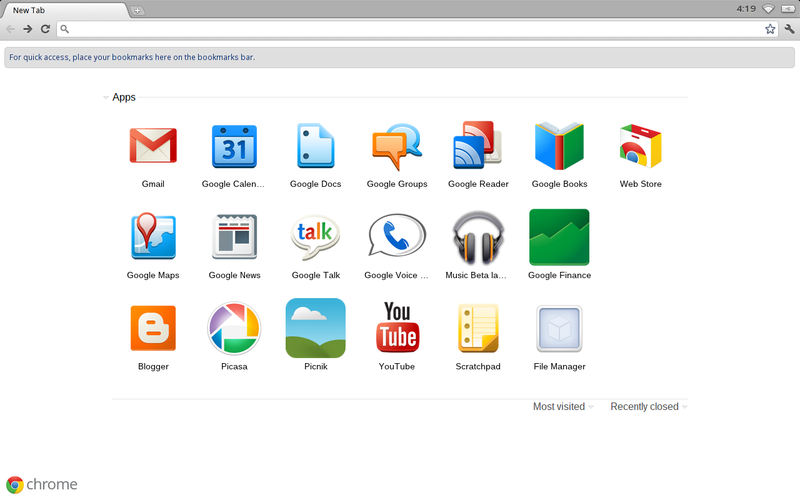
Chromebook's user interface takes a minimalist approach, resembling that of the Chrome web browser. Since Google Chrome OS is aimed at users who spend most of their computer time on the Internet, the only application on the device is a browser incorporating a media player and a file manager.

The first commercial Chromebooks for sale were announced at the Google I/O conference in May 2011 and began shipping on 15 June 2011. They are produced by Acer Inc. and Samsung. You can get more insight on the Chromebook's official page.
  • Chrome Remote Desktop: Another Secret Viewer? OMG!
Logging remotely from an iMac into a Windows using Chrome Remote Desktop: source CNET News
Chrome Remote Desktop is an extension that allows users to remotely access another computer through the Chrome browser or a Chromebook. Released on 7 October 2011, Chrome Remote Desktop is a browser-based equivalent of remote desktop software for conventional operating systems. It is fully cross-platform, so you can connect any two computers running Chrome browser, including Windows, Linux, iMac and Chromebooks. The extension seeks to demonstrate chromoting, the Chrome Remoting technology, and get feedback from users.

Apparently, there are mixied reactions form users around the globe, some of whom have been posting comments on the extension's official page. I am sure, this is one of the extensions that Firefox fans (like me) will be jealousy of.

Wednesday, August 03, 2011

Edmond Kachale: From Health Informatics to Enterprise Informatics


My beloved readers,

I would like to make a few announcements:
  • As some of you may have noted, I have been hired by NBS Bank Malawi LTD. Beginning from  18 July 2011, I will be working enterprise information systems for the bank. These will range from web based, through to desktop and mobile apps. These systems will provided services within the bank, cross-bank transactions as well as e-banking (e.g:  online payments of services). Due to this change of interest, I will not be actively developing health informatics systems as I used to. However, I will still be making contributions where possible.
  • As a natural language enthusiast, I will still be developing and maintaining  my natural language applications. This is one of the greatest contributions I feel I can make to the world apart from my routine businesses. As usual, I will be posting developments here to keep you updated. For those that love toying around with code, I will hosting source code for selected applications on my Github repository. I hope you will enjoy not only using the code but also contributing to it.
  • For obvious reasons :-), I have reduced Ruby development. Currently, I have switched to PHP and .NET. Honestly, I do not find PHP as exiting as Ruby, but the conditions have forced me to make this change. So far,  I have not found a better PHP framework like Ruby on Rails (I know Symfony and CakePHP are trying their best, but they haven't reached there!!).
 I appreciate your wonderful support in my open source development.

Wednesday, June 22, 2011

Meet the Lazyrussian, a hacker that played monkey tricks with Facebook for two-and-half years

Most of you who are reading this post may not have any knowledge as to who The Lazyrussian is. Despite that, most of you may have used his software. I was the same a few months ago. I have never thought very much about Lazyrussian until recently when I visited a homepage of one of his popular technologies and found that he announced that he has ceased developing the software and will no longer host it due to pending lawsuits from Facebook.

He goes by the name Arthur Ariel Sabintsev but he uses to call himself The Lazyrussian or just Lazyrussian in software development circles. He is a twenty-five year-old 'May' baby.  He has a combination of talents. He is an naturally born software developer who holds an undergraduate degree in Biophysics and a graduate degree in Nuclear Physics. He has never done any professional course in software development but has grown a cowboy developer since he was twelve years old.

To his credit, Lazyrussian has developed the following free and open source tools: Buzz It!, Email This!, Email Yourself!, MySpacePAD and FacePAD/PhotoJacker. On 16th June 2011, he announced on his website (http://www.sabintsev.com) that he has foregone his PhD in Physics in pursuit of his software development passion. He also mentioned that he has been hired by Fueled, a New York based software development company where he is honing his programming skills as an iOS/Android developer from 20th June 2011.

Arthur came into my limelight when I was looking for a simple tool that would help me easily download photos from Facebook when I need them. I was looking for a tool that would help me get high resolution photos, because manually downloading them was not giving me the expected quality. One day, I stumbled upon an article that described five technologies that would help me do that. I tried using all of them, but unfortunately none came closer to FacePAD. I finally fell in love with FacePAD.

FacePAD was a simple Firefox extension that would expeditiously download a single photo or an entire photo album off Facebook in few minutes. A Firefox extension is a piece of software, also referred to as an add-on or a plugin, that you can install as part your Firefox Web Browser. Lazyrussian went ahead to release FacePAD on Mozilla's Addons page for public use. On 12 January 2011, Lazyrussian announced that Facebook’s lawyers wrote him stating that he should rebrand FacePAD within 48 hours, or he would be slapped with a lawsuit.  So, the developer enacted his contingency plan and rebranded FacePAD as PhotoJacker.

On a sad note, Lazyrussian announced on PhotoJacker.com on 27th January 2011 that he has ceased from developing the software and has removed from Mozilla because Facebook had sent him a Cease & Desist notice stating that PhotoJacker/FacePAD violates Section 3.2 of their Statement of Rights and Responsibilities. In the notice, Facebook also stated that the developer was opening himself to claims that he is facilitating copyright infringement via the download of the albums of others. The notice also advised him to build something using Facebook APIs rather than working around or contravening Facebook’s limitations, or, make a suggestion to Facebook for functionality he would like to see.

From his two announcements  (about name change and Cease & Desist / Facebook Takedown Notice), and from the copy of Facebook's Cease & Desist notice that I got pa Kanjedza (under the palm tree), it appears that the discussion between the two parties on FacePAD had been around for a while. On the other hand, I personally noticed that Facebook had been frequently changing links to users' photos and photo albums over the past two years. The Lazyrussian kept updating his software till he got this strong warning on 26 January 2011, and finally gave up the fight on grounds that he was a full time student and he really didn't have the time to deal with this issue.

From the word of his mouth, and indeed, from my own opinion, FacePAD was not intended to be of any evil intentions. It developed as an out-of-play alternative way for downloading photos from Facebook. Such application is technically called a hack not a crack. FacePAD was a cool tool that made use of AJAX requests, regular expressions and some built-in Firefox functionalities to download the photos. Facebook was extremely upset that he was able to create this photo-downloading software without using their API. Lazyrussian thinks he was getting punished for being clever. On 16 June 2011, Lazyrussian joined Github and decided to publish FacePAD's source code under copyleft license in an attempt to preserve it.

It was very fascinating to see how a student hacker was making Facebook's life miserable. But Facebook also started as a student hacker's invention at Havard!

There goes The Lazyrussian and his controversial FacePAD!